Proactive climate adaptation that incorporates climate justice principles involves taking practical actions to build the capacity of Central Australian communities while rapidly reducing greenhouse gas emissions, including actions to strengthen housing and energy security, manage climate-stressed land and water resources and assess climate risks at the local level.
Central Australian communities are already experiencing the impacts of climate change. Extreme heat, increased fire weather, more variable and intense rainfall, impacting water and food insecurity, biodiversity loss, accelerated buffel grass invasion and severe economic costs threaten a healthy future in the desert. We are living in the environments that are now acutely impacted by global heating.
Climate change disproportionately impacts remote and very remote communities, where poor housing, pre-existing health-conditions, degraded environments and low levels of services and support, compound the the very real impacts of global heating. A focus on equitable climate change adaptation, hand-in-hand with emissions reductions, is critical for protecting our communities and environment as life gets hotter and harder across our regions.
Monitoring record heat and extreme weather events
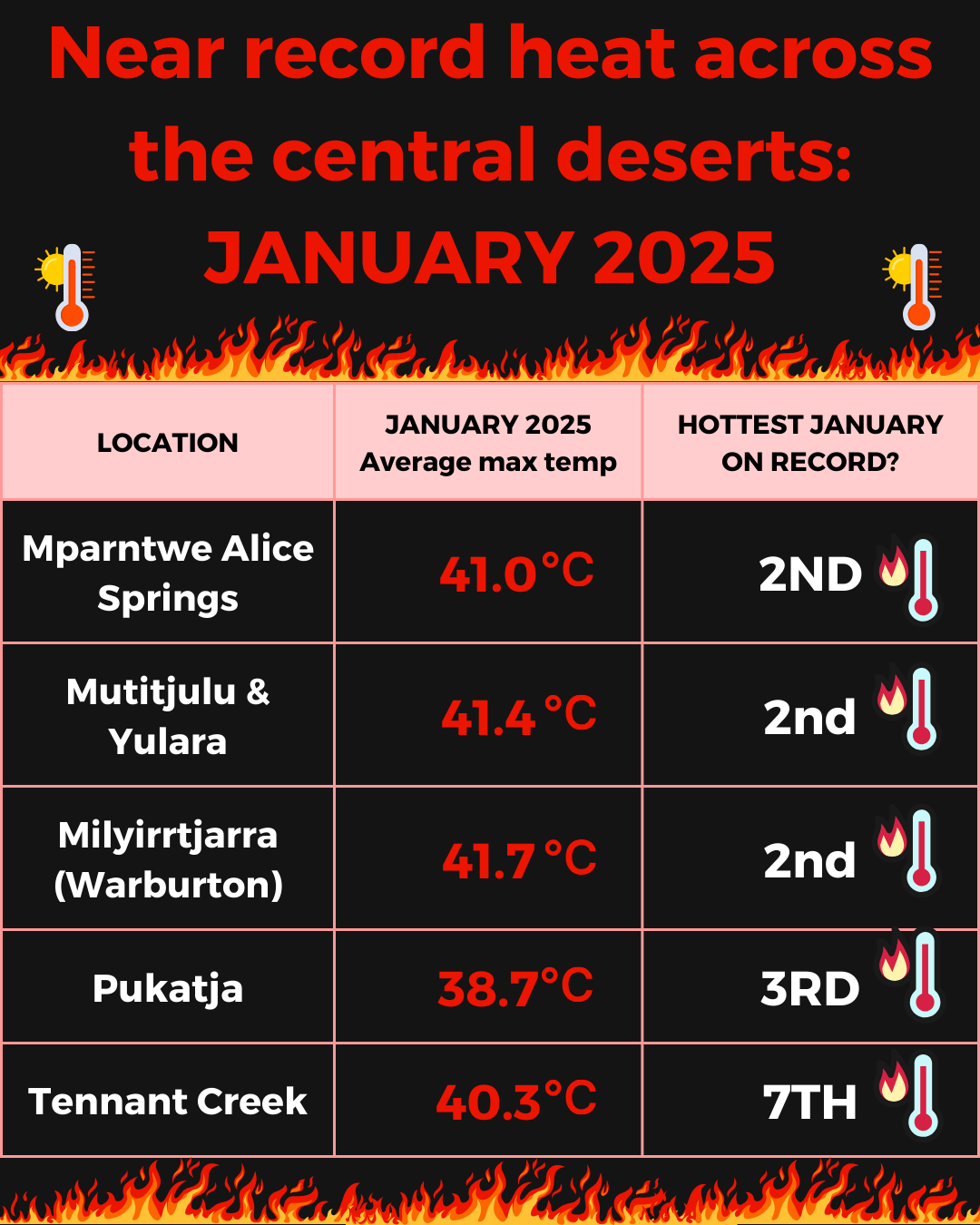
ALEC acts as the central deserts canary in the coal-mine, monitoring extreme weather events, and advocating to ensure our desert communities are not ignored by decision-makers across the continent. How arid environments are affected by global heating is a lesson for the rest of the continent as drying conditions accelerate.
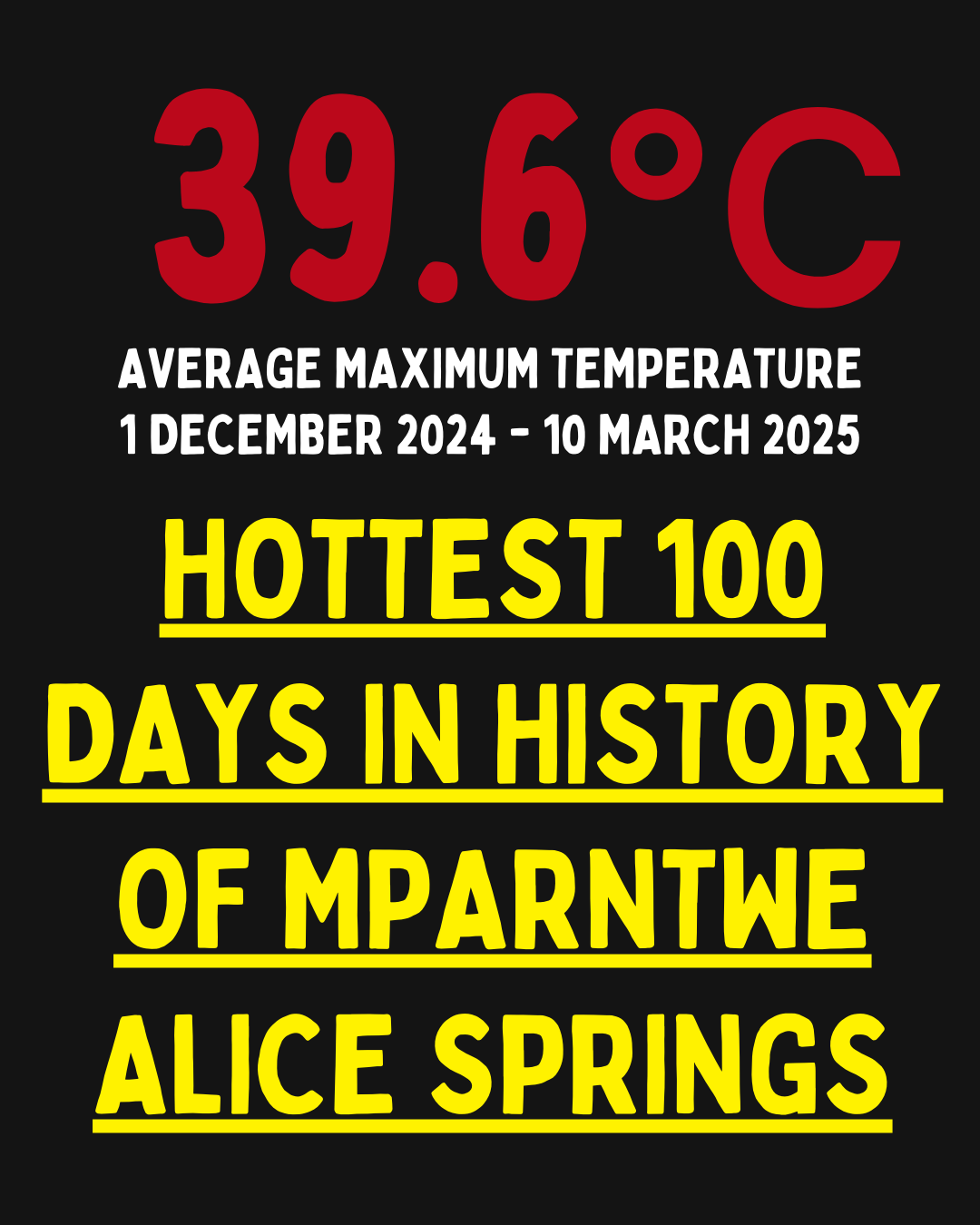
24/25 Summer: Hottest 100 days in Mparntwe Alice Springs history.
Climate adaptation as an opportunity for climate justice
Responding to our changing climate is an endeavor that must be led with and by the local affected community. Climate adaptation is a key opportunity to build capacity, honour the knowledge and expertise of remote and very remote communities and co-design solutions that will work. Climate adaptation must bring communities along that area already responding to the real impacts of climate change.
Climate adaptation Plans and Australia's First Climate Risk Assessment
ALEC is engaged with the Australian Government's process to develop the first ever national climate risk assessment. This work commenced at the end of 2023 and is ongoing. It has included presenting to stakeholders around the continent about the impacts of climate change to the arid lands, multi-day workshops interstate and many online meetings. ALEC hopes that Australia's first climate risk assessment establishes a framework to boost coordination and targetted climate adaptation activities around the country.
The Northern Territory is falling behind and exiting the energy transition. It is also failing to respond to the impacts of climate change already affecting Territory communities. ALEC considers it a matter of urgency that the NT Government develop a Climate Adaptation Plan, in addition to supporting local Government to develop and implement Regional Adaptation Plans. These strategies need to be informed by local knowledge and people to ensure our communities are strong and prepared. Climate adaptation will require collaboration across sectors and organisations. ALEC is working to bring together a diverse group of actors across the Territory to seek opportunities for collaborative adaptation in the NT, and support cross-sector advocacy for climate adaptation.
- Learn more by downloading our guide 'What is climate change adaptation, and why does it matter?'
Climate change science
The Territory is already a place of climate extremes, and climate change is increasing the intensity, frequency and variability of climatic events. In Central Australia this means hotter temperatures (Figure 1), more intense heat events, longer periods in drought, more intense rainfall events, more erratic rainfall and aquifer recharge (Figure 2), increasing the likelihood of major flood events (noting that Alice Springs is built on a flood plain), drier soils, increased evapotranspiration, more wildfires and increased risk of erosion. The realities of climate change are stark with its impacts cascading and climate change will increase the stress on existing and new infrastructure, from roads, pipelines and power stations, to housing, telecommunications, transport and water assets.
In January 2019, the average daily maximum temperature in Alice Springs was 41.5℃, 5℃ above the average maximum temperature for January. Under a high emissions scenario, by the end of the century we can expect every second day in Alice Springs to be above 35 degrees, nearly double the historical average. Tennant Creek and Elliott will see close to an extra 100 days above 35℃ across the same period. In Alice Springs between 1989-2018, there were six-times more days above 44℃ than between 1959-1988. Tennant Creek across the same period has experienced 7 days a year above 44℃ compared to zero in the 30 years prior. Alice Springs has warmed by 2℃ comparing the annual maximum temperatures between 1942-1951 and 2012-2021 (Figure 1) and similar trends can be found across Central Australia. An increased variability and intensity in rainfall has been observed in Alice Springs (Figure 2), with a median rainfall of 237.9mm recorded across the historical record.
Climate change also further threatens already at-risk ecosystems. It is understood that arid and semi arid environments, and Georgina Gidgee woodlands are undergoing collapse, (as are savannah and mangrove environments in the Top-End). This is due to temperature and precipitation changes, habitat change and loss, invasive species such as buffel grass, livestock, agriculture and water extraction. Collapse is understood as an ecosystem which has undergone as ‘a change from a baseline state beyond the point where an ecosystem has lost key defining features and functions and is characterised by declining spatial extent, increased environmental degradation, decreases in, or loss of, key species, disruption of biotic processes, and ultimately loss of ecosystem services and functions’. It is important to consider how the state of the Northern Territory’s environment impacts future infrastructure planning.